

Reviewed · TIRANA CITY WALKING TOURS
Durrës: Walking tour with Roman Amphitheater
Roman stones in Durrës have a story. This walking tour focuses on the Roman Amphitheatre with a local angle, so you’re not just looking at rocks. I like that it’s short and pointed, and you get a real sense of what the site meant to ancient visitors.
Two things I especially liked: the guide keeps the ruins understandable, and the entrance ticket is included in the price. It also runs from the central Sheshi Liria area, and the whole experience is built for an easy 1 hour 30 minutes.
The main drawback is expectations. The amphitheatre is partly earth-covered and not maintained like a polished museum, so you may see missing or faded elements and it might not feel huge or dramatic on first glance.
In This Review
- Key highlights if you like Roman ruins done fast
- A one-stop walk to the Roman Amphitheatre in Durrës
- Meeting at Sheshi Liria and why 1.5 hours works
- What you’ll see: the amphitheatre’s “big once, smaller now” reality
- The guide’s value: making ruins readable (not just photogenic)
- Admission included and the mobile ticket convenience
- Price of $40.65: does it feel worth it?
- Small group size, walking pace, and weather reality
- The on-the-ground expectation: what might disappoint you
- Who this tour fits best
- Should you book this Durrës Roman Amphitheatre tour?
- FAQ
- Where does the tour start and end?
- How long is the Durrës Roman Amphitheatre walking tour?
- Is the entrance ticket included?
- Do I need to bring anything for the ticket?
- How many people are in the group?
- Is there a minimum number of travelers?
- What’s the cancellation policy if weather is bad?
Key highlights if you like Roman ruins done fast
- Local-led context for what you’re looking at, not just a quick pass-by
- Entrance ticket included, so you’re not hunting for paperwork or extra fees
- Mobile ticket format, handy when you’re moving around Durrës
- A single main stop at the amphitheatre, designed for a focused visit
- Small group size up to 15, which usually keeps questions possible
- Good weather matters, because this is a walking-and-standing type of visit
A one-stop walk to the Roman Amphitheatre in Durrës
This experience is simple by design: you start in the Sheshi Liria area in Durrës and you go to one place—the Durres Amphitheatre—then you’re back where you started. That sounds basic, but it’s actually a strength if your time in town is tight. You’re not bouncing between a bunch of stops where you spend more time traveling than learning.
The vibe here is Roman public entertainment and engineering you can still read with your own eyes. Even when the site isn’t “fully restored,” the scale of the amphitheatre concept lands. And with a local guide, you get the sense of how it would have worked when it was active, rather than just hearing dates.
If you’re the type who likes your ruins with a little human explanation—what people did there, how they gathered, why it mattered—you’ll get more out of the hour than you might expect.
More Tirana walking tours through the boulevards and back lanes



Meeting at Sheshi Liria and why 1.5 hours works
You meet at Sheshi Liria, Durrës, Albania and the tour ends at the same spot. That round-trip matters. You’re not trying to figure out where you end up, and it’s convenient for looping back to food, cafés, or other plans.
The total time is about 1 hour 30 minutes. With one main stop, that usually means you’ll spend roughly 30 minutes at the amphitheatre and the rest is the walking time plus the guide’s setup and orientation. For many people, that’s the sweet spot. Long enough to get context and look around, short enough that you won’t feel trapped if you’re tired or the heat is rising.
Also, the meeting point is described as near public transportation, which is useful if you’re arriving from elsewhere in the Tirana–Durrës orbit and want an easy start.
Practical note: because this is outdoors, plan to dress for walking and standing. The tour’s length is compact, but you’ll still want comfortable shoes.
What you’ll see: the amphitheatre’s “big once, smaller now” reality
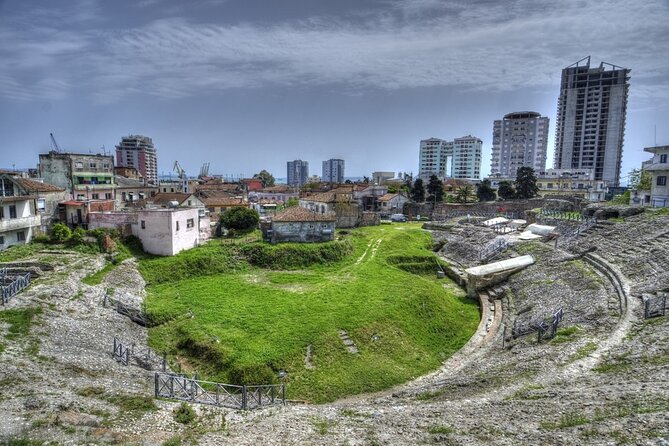
This Roman Amphitheatre is tied to Emperor Trajan in the story you’ll hear. According to the account shared during the visit, Trajan had it built in the 2nd century, and it was intended to be the larger amphitheatre of the Balkans, with a capacity of about 20,000 people.
That’s the kind of detail that changes how you look at the ruins. Instead of thinking, “This is all that’s left,” you start thinking, “This is what would have held thousands.” Even if the visible seating and decorations are incomplete, the purpose is still there: a major venue for crowds.
There’s also a “why it changed” piece to the narrative. The amphitheatre’s glory is described as fading around 350 AD, linked to a violent earthquake. That kind of cause-and-effect is exactly what a guided stop helps with. You can see damage and missing sections, but the guide helps you make sense of why it looks the way it does today.
One more reality check: parts of the site may feel less imposing than the hype in your head. It can be partly under the ground, and that affects how dramatic the structure looks from street level. So if your brain expects a fully exposed, tall, movie-set amphitheatre, you might have to adjust your mental camera.
The guide’s value: making ruins readable (not just photogenic)
A lot of walking tours in historic sites are mostly pacing. This one aims for interpretation, and that matters most when the site isn’t perfectly preserved. When inscriptions are missing or elements are hard to spot, you need a guide to point you toward what counts.
In particular, you’ll benefit if you like learning the “reading order.” For example: where people would have sat, what the space is for, and how the amphitheatre functioned as a crowd space. That’s the difference between seeing a flat set of stones and understanding how a venue shapes movement and sound.
I also appreciate that the tour is designed for a maximum of 15 travelers. With a smaller group, it’s easier to ask a question and for the guide to adjust to the pace of the group. You’re less likely to get rushed through.
One more practical point: the amphitheatre is described as accessible, so you don’t need special logistics to enjoy it. Still, it’s worth arriving with curiosity. The best experience here comes from looking closely and letting the guide translate what you’re seeing.
Admission included and the mobile ticket convenience
You get an entrance ticket as part of the experience, which is a real value-add. It removes one layer of hassle—no last-minute ticket hunt, no extra cost surprise at the door. For a compact 1 hour 30 minutes, that saves time and keeps the visit smooth.
The tour also uses a mobile ticket. That’s helpful when you’re bouncing around town and don’t want to keep track of paper receipts. Just make sure your phone battery is okay before you go. It’s a small thing, but in practice it prevents the classic scramble.
Note how this shapes the experience: because the ticket is already handled, your attention stays on the ruins and the guide’s explanation. That’s exactly what you want from a short tour.
More Apollonia and ancient Illyrian sites we have walked from Tirana



Price of $40.65: does it feel worth it?
The price is $40.65 per person. For a 1 hour 30 minutes walking experience with a guide and an included amphitheatre entrance ticket, I think the value depends on how you travel.
If you enjoy guided context—especially for Roman sites that aren’t fully restored—then the price starts to feel reasonable fast. You’re paying for interpretation plus the ticket, not for a long itinerary.
If you’re the kind of traveler who prefers to wander solo and read signs at your own pace, $40.65 may feel steep for a single-stop visit. In that case, you might ask yourself: do I want someone to help me interpret what I’m seeing in real time? If the answer is yes, you’ll likely feel like it was money well spent.
There’s also an important condition: a minimum of 2 persons is required. Practically, that means if you’re traveling solo, you’ll want to confirm there’s someone in your same time slot or that the operator can still run your departure. It’s not a problem if you’re flexible, but it’s good to know.
Finally, the tour is described as being booked about 129 days in advance on average. That suggests steady demand. If your dates are fixed, booking earlier can be smart.
Small group size, walking pace, and weather reality
This experience caps at 15 travelers, and that’s a solid size for a quick stop like this. It keeps things from feeling like a stampede. It also makes it easier for the guide to answer questions and for you to hear explanations without fighting the noise.
The tour is said to require good weather. Because this is an outdoor setting and the experience depends on walking and standing, you should treat weather as a real factor, not a minor footnote. If conditions are bad, you may be offered a different date or a full refund.
Since most people can participate, you can likely join even if you’re not a hardcore hiker. But keep it realistic: you’ll still be walking in town and spending time looking around the amphitheatre area, so comfortable shoes matter more than anything.
Also, this is a meeting point start-and-finish tour. That’s helpful if you want to slot it between lunch and another activity without feeling like you need to plan your whole day around one attraction.
The on-the-ground expectation: what might disappoint you
Let’s talk straight about the potential letdowns, because this ruins the experience for no one except people who arrive with the wrong mental picture.
First, the site may not feel “kept up” in the way you might expect from major, heavily funded attractions. Some elements can be missing, including illustrative inscriptions. Second, the amphitheatre may feel less imposing than the numbers suggest, partly because a large portion is still underground.
That’s not a reason to skip it. It’s a reason to approach it differently. Treat it like a Roman structure in transition—part architecture, part archaeological footprint, part historical story. If you go in expecting every carving to be crisp and every seating tier to be fully visible, you may feel underwhelmed.
If you go in expecting a guided explanation plus a chance to picture 20,000 people in a space that still has the bones of that past, you’ll probably enjoy it more than you think.
Who this tour fits best
I’d steer you toward this experience if:
- You like Roman sites but want the “help reading the ruins” part
- You’re short on time and want a single, focused stop
- You prefer a small group with room to ask questions
- You appreciate practical tour formats like mobile tickets and an included entrance ticket
I might suggest you consider other options if:
- You dislike guided tours and prefer total self-paced freedom
- You’re hunting for a heavily restored, visually dramatic amphitheatre
- You need a long, multi-stop itinerary rather than a quick hit
Should you book this Durrës Roman Amphitheatre tour?
If your priority is a straightforward, guided Roman stop in Durrës, I’d say yes. The combination of local-led context, included entrance, and a tight 1 hour 30 minute format is a strong match for travelers who don’t want to waste half a day to see one major site.
If you’re price-sensitive or you’re already great at interpreting ruins on your own, you might pause. For those travelers, the amphitheatre’s condition and partly underground layout could feel less thrilling without the guide.
My practical advice: book it if you want the explanation and convenience. Skip it if you only care about maximum photo spectacle.
FAQ
Where does the tour start and end?
The tour starts and ends at Sheshi Liria, Durrës, Albania.
How long is the Durrës Roman Amphitheatre walking tour?
It lasts about 1 hour 30 minutes (approx.).
Is the entrance ticket included?
Yes. The entrance ticket for the Roman Amphitheatre is included.
Do I need to bring anything for the ticket?
You’ll use a mobile ticket.
How many people are in the group?
The tour has a maximum of 15 travelers.
Is there a minimum number of travelers?
Yes. A minimum of 2 persons is required for the tour to run.
What’s the cancellation policy if weather is bad?
You can get a full refund with free cancellation up to 24 hours in advance. The tour also requires good weather; if it’s canceled due to poor weather, you’ll be offered a different date or a full refund.
More Durres and Adriatic Coast Days




More Apollonia and Ancient Illyrian Sites

More Ways to Walk Tirana on Foot


Not quite it? More Tirana tours and Albanian day trips fresh off our review desk








Tirana City Walking Tours, compared.
 ★ 5.0Walking Tour of TiranaFrom $18646 reviews
 ★ 5.0Local food experience & walking tour of TiranaFrom $60192 reviews
 ★ 5.0Tour a Piedi di TiranaFrom $20174 reviews
 ★ 5.0Best of Local Food & City Tour of Tirana – Food & Drinks IncludedFrom $72160 reviews
 ★ 5.0Berat Walking TourFrom $1886 reviews
 ★ 5.0Tirana Hidden Treasures Sightseeing TourFrom $1660 reviews
 ★ 4.5City Tour of Tirana & Dajti Mountain with PickupFrom $6059 reviews
 ★ 5.0Tirana Walking Tour: History, Culture &Gems by a Passionate GuideFrom $3652 reviews
Browse the lists this tour appears in