
Reviewed · TIRANA CITY WALKING TOURS
TIRANA Walking Tour: Discover the ever-changing capital city
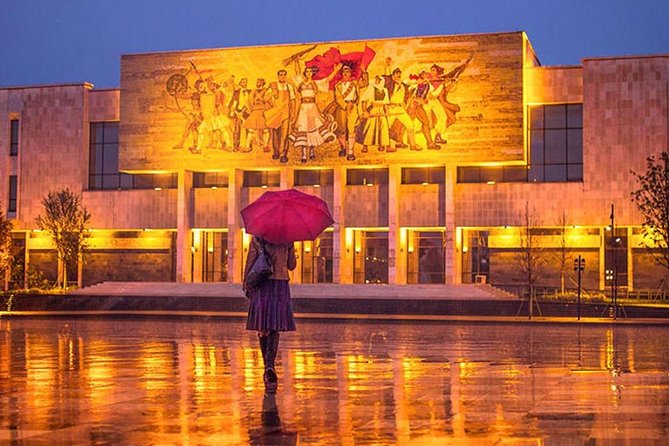
Skanderbeg Square sets the tone for Tirana. I like this tour because it’s built for real on-foot orientation and fast context about how Albania’s 20th century shaped the city you see today. You also get a guide who connects buildings to stories, not just a list of sights.
Two things I especially love: you visit key landmarks with tickets included where it matters, and you move at a human pace through neighborhoods that still feel lived-in. The one consideration is simple: it’s a walking tour, and the route works best in good weather—so plan your shoes and your sun protection.
This is the kind of tour where the guide’s energy matters. I’ve seen names like Gloria and Ilir mentioned for clear English and patient, history-focused explanations, and that matches what you want when the city’s past is layered and change-heavy. If you only have a day or two in Tirana, this helps you get your bearings fast; if you’re looking for deep museum time, though, you’ll still be out walking most of the hours.
In This Review
- Key highlights you’ll actually feel
- Start at Skanderbeg Square, where Tirana keeps rewriting itself
- Climb the Clock Tower: 90 steps, 35 meters, and construction in view
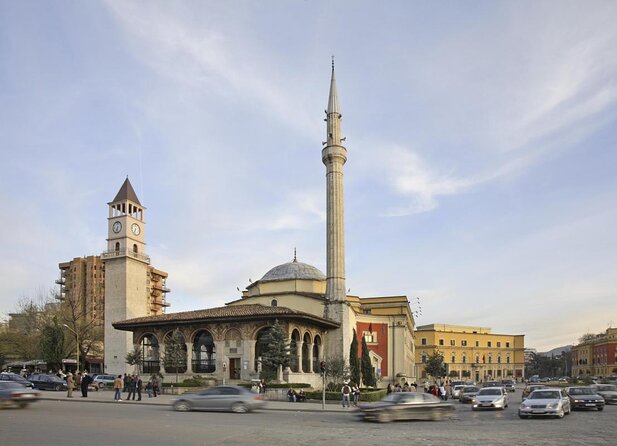
- Et’hem Bej Mosque: a survivor of political extremes and a lesson in restored art
- Down Rruga Murat Toptani toward the castle area and Tirana’s makers
- Tanners’ Bridge near Parliament: Ottoman stone, a redirected river, and a restored pond
- National Gallery of Art outside: social realism statues and Reja’s Cloud
- Blloku: from party elite zone to the nightlife pull of today
- How the 3 to 4 hours works (and why the pacing makes sense)
- Price and value: what $42.10 buys you in real terms
- What to expect from the guide you’ll get (and how to get the most)
- Should you book this Tirana walking tour?
- FAQ
- What is the duration of the Tirana walking tour?
- How much does the tour cost?
- What time does the tour start, and where does it end?
- Is hotel pickup and drop-off included?
- What’s included in the tour price?
- Are food and drinks included?
- What language is the tour offered in?
- How large are the groups?
- What if the weather is poor?
- Is tipping included?
Key highlights you’ll actually feel
- A guided walk that stitches the 20th century together while you’re standing in the places it happened
- Tickets included for the National Historical Museum, Clock Tower, and Et’hem Bej Mosque
- 90 steps up the Clock Tower for a rare panoramic view of the center
- Tanners’ Bridge: an Ottoman-era footbridge restored in the 1990s, with an artificial pond that’s now pedestrian-only
- Blloku’s shift from communist elite zone to today’s nightlife and institutions
- A route capped at 15 travelers, so it’s easy to ask questions
Start at Skanderbeg Square, where Tirana keeps rewriting itself
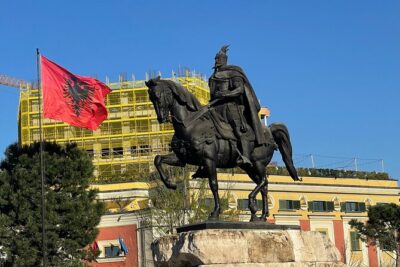
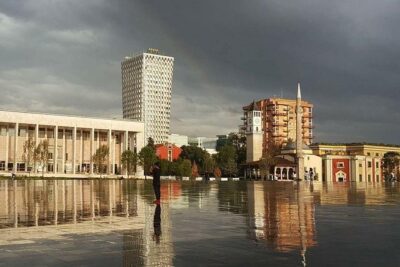
Skanderbeg Square is a good first choice because it’s instantly readable. You’re in the heart of Tirana, and the square’s buildings help explain why the city doesn’t look like one single era. Even the naming points to a national hero, which is Tirana’s way of telling you history isn’t background noise here.
From this central spot, you’ll get your bearings for what’s around you: the National Historical Museum, the National Opera House, the Old Clock Tower, and Et’hem Bej Mosque are all part of the wider square orbit. That matters because later stops feel less random—you recognize streets and landmarks you’ve already learned to “read.”
I also like the way the guide frames the complexity of Albanian history without getting academic. Expect facts and curiosities tied to the main buildings and the layered development of the 20th century, so Tirana feels understandable instead of overwhelming.
More Tirana walking tours through the boulevards and back lanes


Climb the Clock Tower: 90 steps, 35 meters, and construction in view
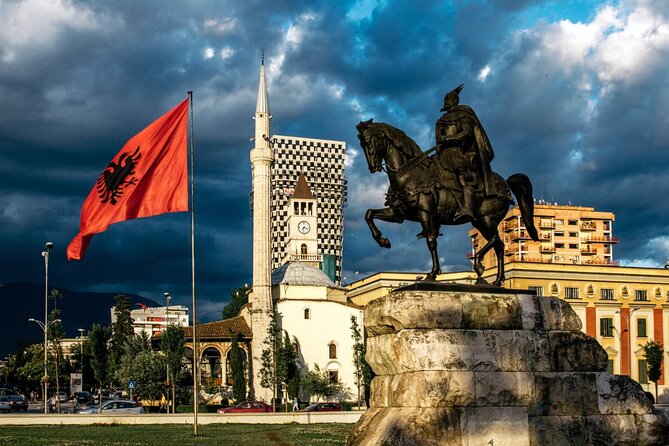
The Clock Tower stop is short, but it’s built for payoff. It opened to tourists in 1996, and getting up takes about 90 steps—so you’ll feel you earned the view. The tower itself is 35 meters tall and dates to Ottoman-era Tirana, built around 1840.
Here’s the interesting part: you’re not just looking at a pretty postcard skyline. You’re looking at a city with active change happening around it, including ongoing construction of taller buildings. That visual contrast helps you understand Tirana as an evolving capital, not a museum set.
The practical upside is time. If you come early and the group keeps a steady pace, this is an efficient climb that gives you a strong mental map of the city center before you move into smaller historic corners.
Et’hem Bej Mosque: a survivor of political extremes and a lesson in restored art
Et’hem Bej Mosque is one of the clearest “this still matters” moments on the walk. Built in 1823, it’s described as the only religious monument to have survived Albania’s Cultural Revolution era. That survival is the story behind the visit, not just the architecture.
When you get there, you’ll be looking for the signs of restoration. Newly restored floral patterns and vivid frescos are part of what stands out, and the guide adds context about the nuanced history of Islam in Albania. I appreciate this approach because it avoids the common trap of treating religion as generic scenery.
You’ll also be standing in the city center, where mosque, politics, and modern life all sit close together. That closeness helps you see why Tirana’s identity is built from many layers at once.
Down Rruga Murat Toptani toward the castle area and Tirana’s makers
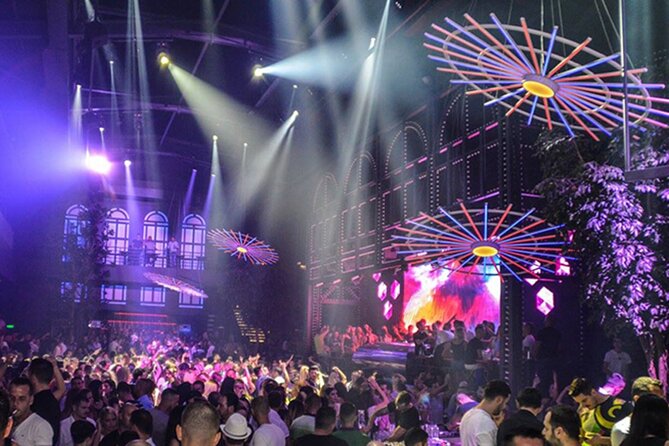
From the mosque area, the walk shifts toward a different kind of discovery. Rruga Murat Toptani is the corridor that leads you toward the Tirana Castle zone, and the point isn’t that you’ll find intact walls waiting for you. Instead, you learn why the area still counts as historical even when so little remains visible.
There have been excavations in 2001 and 2008, and traces of the castle walls reportedly go back to Emperor Justinian’s period (4th–6th century). That’s a big span, and the guide’s explanation helps you connect old timelines to the present-day city feel.
Now, the reality on the ground is more “atmosphere” than “ruins.” With wars and destruction over time, the castle walls don’t survive in a dramatic way. But the area has turned into a popular spot for arts and artisans, with cafés, restaurants, and art galleries. I like that this stop gives you both history and a sense of what Tirana does with historic space today.
Tanners’ Bridge near Parliament: Ottoman stone, a redirected river, and a restored pond
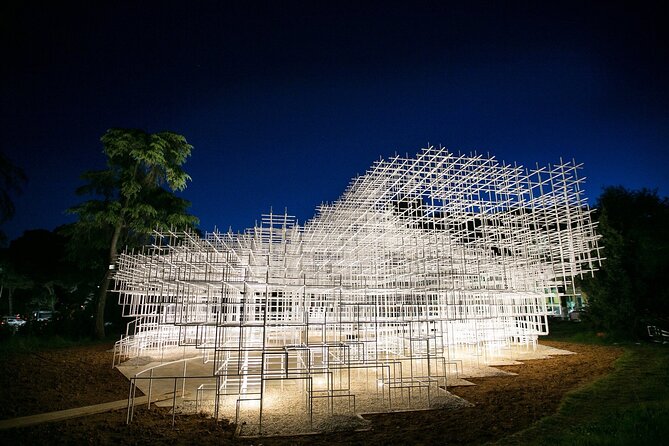
Ura e Tabakëve, also called Tanners’ Bridge, is one of those stops that makes the tour feel specific. It’s an 18th-century Ottoman period stone footbridge located near the Albanian Parliament, and it tells you something about Tirana as a working city, not only an administrative one.
The bridge’s name comes from the tabakë profession, tied to farmers moving produce and livestock. That matters because you’re not just looking at an old structure—you’re picturing daily movement across the Lana stream, which the bridge originally crossed until the 1930s, when the river was diverted.
The restoration story is also practical to know. In the 1990s it underwent a serious restoration: stones were cleaned and original materials were restored, and an artificial pond was recreated on both sides. Now it’s used by pedestrians only, which gives the bridge a calm, lingering feel compared with the broader center.
This stop is short, but it’s a strong example of how Tirana preserves history while reusing it for modern life.
More Tirana walks worth putting your boots on for



National Gallery of Art outside: social realism statues and Reja’s Cloud
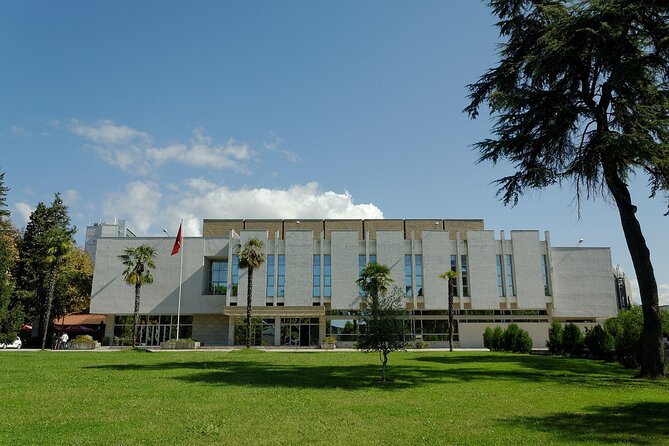
The National Gallery of Art stop is a bit of a different animal. The Albanian National Gallery of Arts (GKA) was established on January 11, 1954, and it’s known for social realism masterpieces plus strong figurative art from Albania. But there’s a key limitation: it’s temporarily closed for expansion.
So what do you do? You’ll observe the minimalist design from the outside. You’ll also see social realist statues of Eastern European Communist leaders like Stalin and Lenin in its vicinity. If you’re curious how political art shows up in public space, this external viewing is still meaningful.
Right in front of the gallery is Reja—also known as The Cloud—designed by Japanese architect Sou Fujimoto. It’s become a beloved spot for late night film screenings, performative arts festivals, and live concerts. That’s a nice contrast: heavy political-era art and a modern public gathering space sitting side by side.
Admission here isn’t included, and since the building itself is closed, set your expectations accordingly: this is a “what you can see without ticketing” stop, not a full gallery visit.
Blloku: from party elite zone to the nightlife pull of today
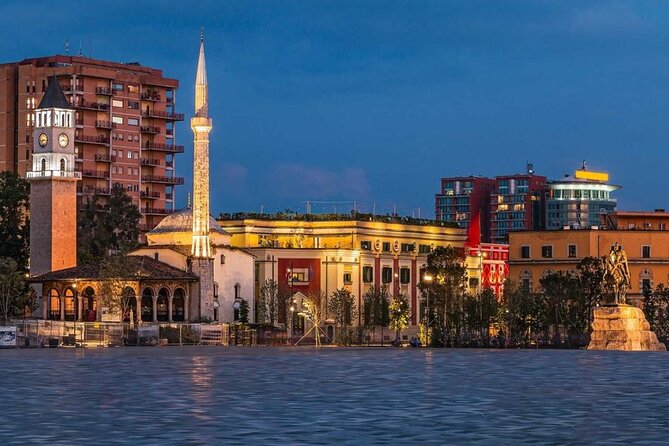
Blloku is the emotional payoff stop. The area is now Tirana’s must-visit gravitational pole, where hip bars and cafés meet luxury boutiques and upscale residential life. The modern vibe is obvious when you arrive, but the tour keeps it grounded by explaining what the neighborhood used to be.
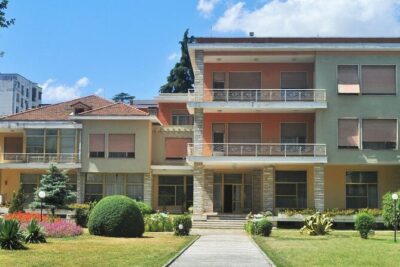
During Communist rule, Blloku was a closed-off precinct for the party elite. At its heart was the villa of Albania’s long-ruling dictator Enver Hoxha, beside the house where so much fate was decided. Nearby is the Presidenca e Republikës, the office of the Albanian president.
I like how this stop forces you to hold two timelines at once: today’s street energy and the institutional history behind it. It’s also a helpful location for planning your next hours in Tirana. If your timing matches, you can roll right into the cafés and bars afterward without needing to relocate.
How the 3 to 4 hours works (and why the pacing makes sense)
This tour is built for efficiency. You start at 9:30 am at Tirana International Hotel on Sheshi Skënderbej 8, then you return to the same meeting point at the end. With a 3 to 4 hour duration and a small group size (up to 15 travelers), it’s long enough to build context, but short enough to fit into a travel schedule.
The best part is how the route alternates “big view” and “close detail.” You get the big-city orientation at Skanderbeg Square, then you climb for city center panoramas, then you step into smaller, specific heritage moments like the mosque, bridge, and gallery area. That rhythm keeps attention high.
You’ll want to pace yourself for two reasons:
- Some stops are outdoors and you’ll cover ground on foot.
- You may face heat, especially on a hot day. One guide example included making time for a drink stop, and the guide even paid for a local beer named Korça, showing how practical comfort breaks can be.
I’d plan to bring water and wear shoes you can walk in for hours. The tour doesn’t pretend to be effortless.
Price and value: what $42.10 buys you in real terms
At about $42.10 per person for 3 to 4 hours, you’re paying for a guided city orientation plus a few ticketed moments. What makes the price feel fair is that key entries are part of the experience: the National Historical Museum ticket is included, the Clock Tower ticket is included, and the Et’hem Bej Mosque ticket is included.
Other heritage spots are free to view, like the castle-area walk around Rruga Murat Toptani and the Tanners’ Bridge. The National Gallery area is more of an exterior stop since it’s temporarily closed for expansion, with admission not included there.
Food and drinks are not included, and tips aren’t included either. That means you’ll likely spend a bit extra if you want a café pause. Still, for me, the ticket inclusion is what turns this from a generic highlights walk into something that feels like a proper deal.
Also, this matters for decision-making: it’s booked on average 25 days in advance. That usually signals the tour has staying power—because it solves a common problem for first-time visitors: you want to see a lot without wasting time guessing.
What to expect from the guide you’ll get (and how to get the most)
You won’t just get someone who points. The format is a guided walk that explains Albanian history and connects it to what’s around you. Guides like Gloria and Ilir are specifically noted for being informative, patient, and engaging, and that’s exactly what helps when you’re dealing with cultural and political layers.
A smart move is to come with two or three questions in your head. For example: how did Tirana change under Communism, and what remains from that era? When you ask early, you’ll hear better answers all the way through Blloku and the museum-area stops.
There’s also a practical lesson from a past day: if the National Historical Museum happens to be closed, you might get a substitution or an alternative that keeps things moving. I’d treat this as a rare hiccup, but it’s good to know the guide approach can be flexible.
Should you book this Tirana walking tour?
If you want a clear, walkable introduction to Tirana in a half-day, I think this is a strong choice. The ticket inclusions (museum, clock tower, mosque), the small group size, and the way the guide ties buildings to Albania’s 20th century make it feel more than just “photo stops.”
Book it if:
- You only have a limited window in Tirana and want a focused route
- You enjoy context and explanations more than big museum time
- You’re okay with walking for about 3 to 4 hours
Skip it or consider something else if:
- You want a full indoor museum day, since the gallery is described as temporarily closed and museum time is limited
- Bad weather is likely, because the experience requires good weather
If your goal is to understand Tirana quickly and then wander confidently on your own, this is the kind of tour that sets you up for the rest of your trip.
FAQ
What is the duration of the Tirana walking tour?
It runs about 3 to 4 hours.
How much does the tour cost?
The price is $42.10 per person.
What time does the tour start, and where does it end?
It starts at 9:30 am at Tirana International Hotel (Sheshi Skënderbej 8, Tiranë 1001, Albania) and ends back at the same meeting point.
Is hotel pickup and drop-off included?
No, hotel pickup and drop-off are not included.
What’s included in the tour price?
You get a city tour of Tirana and a qualified guide. Tickets are included for the National Historical Museum, the Clock Tower, and Et’hem Bej Mosque. Other stops listed are free to enter.
Are food and drinks included?
No, food and drinks are not included.
What language is the tour offered in?
The tour is offered in English.
How large are the groups?
The tour has a maximum of 15 travelers.
What if the weather is poor?
The tour requires good weather. If canceled due to poor weather, you’ll be offered a different date or a full refund.
Is tipping included?
Tips and gratuities are not included.
More Tirana Tours and Albanian Day Trips
More from Our Tirana Review Desk

More Ways to Walk Tirana on Foot


Not quite it? More Tirana tours and Albanian day trips fresh off our review desk





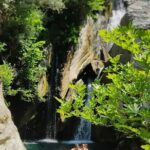
Tirana City Walking Tours, compared.
 ★ 5.0Walking Tour of TiranaFrom $18646 reviews
 ★ 5.0Local food experience & walking tour of TiranaFrom $60192 reviews
 ★ 5.0Tour a Piedi di TiranaFrom $20174 reviews
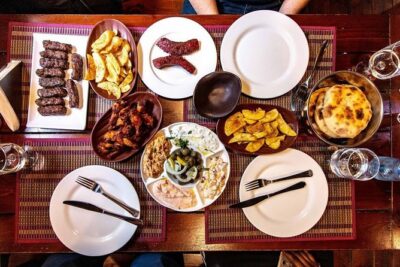 ★ 5.0Best of Local Food & City Tour of Tirana – Food & Drinks IncludedFrom $72160 reviews
 ★ 5.0Berat Walking TourFrom $1886 reviews
 ★ 5.0Tirana Hidden Treasures Sightseeing TourFrom $1660 reviews
 ★ 4.5City Tour of Tirana & Dajti Mountain with PickupFrom $6059 reviews
 ★ 5.0Tirana Walking Tour: History, Culture &Gems by a Passionate GuideFrom $3652 reviews
Browse the lists this tour appears in